Eliza Kitis' publications,
reflecting her teaching areas and special interests, are in the areas of
pragmatics, semantics and discourse analysis. They range from problems with
Grice's implicature, relevance, conjunction, frame theory to literary
discourse, translation, aspect #AspectG and pragmastylistics, as well as news and
advertising discourses, CDA and ideology. Her current focus, however, is on connectives and discourse markers, a topic of
interest since the days of her
Books
-
2012. Semantics. Meaning in Language. Thessaloniki: University Studio Press. Click here for contents and preface.
-
(submitted) Kruse,,Otto, Montserrat Castelló, Helmut Gruber, Eliza Kitis, Madalina Chitez (eds). Genres and Writing Practices in Europe‘s Higher Education: Country Reports, Evaluations and Recommendations.
-
2011. E. Kitis et al. (eds) Selected Papers from 19th International Symposium in Theoretical and Applied Linguistics. Dept of English, Aristotle University. Thessaloniki: Monochromia.
-
2009-2010. Semantics. The fundamentals of meaning in language. Aristotle University, Publications Department (259 pp).
-
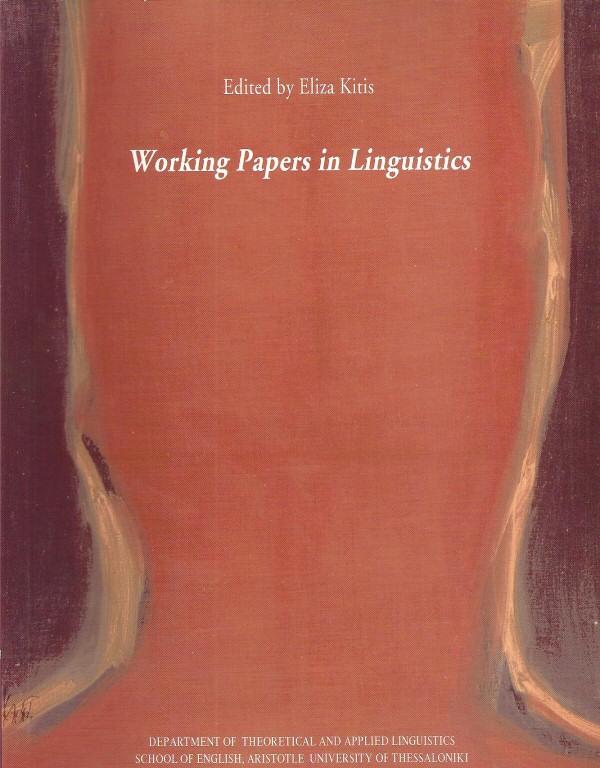
2004. Edited: Working Papers in Linguistics. Dept of Theoretical and Applied Linguistics. School of English, Aristotle University of Thessaloniki. Altintzis,
-
2001. Edited: The Other Within. VII: Aspects of Language and Culture. Thessaloniki: A.A.Altintzis.
-
Pragmatics. The study of invisible meaning in language. [in Greek]. (Awaiting publication).
-
1989. Proceedings of 3rd Symposium on the Description and/or Comparison of English and Greek, Dept of English, Aristotle University. Thessaloniki: University Studio Press (Edited with S. Efstathiadis).


Copyright Notice
The publishers hold the
copyright of these articles. The PDFs are provided here to ensure rapid dissemination
of scholarly work. It is understood that you will use them only in a manner
consistent with the fair use provisions of the relevant copyright laws. You may
not distribute them or use them for any commercial enterprise.
Semantics, Pragmatics, relevance,
implicature [generalized, conventional], definiteness, etc.
·
2009, Emotions
as discursive constructs: The case of the
psych-verb ‘fear’.  In Studies in Cognitive Corpus Linguistics.
Barbara Lewandowska-Tomaszczyk & Katarzyna Dziwirek (eds).
Frankfurt/Main: Peter Lang, 147-172. Access book here: http://www.peterlang.com/Index.cfm?vID=59399&vLang=E
In Studies in Cognitive Corpus Linguistics.
Barbara Lewandowska-Tomaszczyk & Katarzyna Dziwirek (eds).
Frankfurt/Main: Peter Lang, 147-172. Access book here: http://www.peterlang.com/Index.cfm?vID=59399&vLang=E
·
2009,
From motion to emotion to interpersonal function. The case of 'fear'
predicates. (pre-publication version with wrong pagination
and some mistakes). In Language and Social Cognition. Expression of the
Social Mind. Ed. Hanna Pishwa.
· 2001, Introduction. In The Other Within. VII: Aspects of Language and Culture. Ed. Eliza Kitis. Thessaloniki: A.A.Altintzis, 2001, 1-8.
·
1999,
On Relevance again: From Philosophy of Language across 'Pragmatics and
Power' to Global Relevance. Journal of Pragmatics 31, 643-67, 1999. (AbstractJoP31)
· 1999, The case of 'fovame'[fear] and other psychological verbs. (with A. Kakouriotis), Proceedings of 3rd International Conference on Greek Linguistics, Ed. A. Mozer. Athens, Ellinika Grammata, 1999, 131-140. (ICGL3)
·
1998, When Relevance saves. Proceedings of 12th
International Symposium of Theoretical and Applied Linguistics, VI: Papers
on Theoretical Linguistics, ed. S. Lambropoulou,
·
1989,
(Grice1)
Conventional
implicature
revisited. Working Papers in Linguistics and Literature, Department of
English,
·
1989,
((Grice 2)
A
comment on Grice's distinction between semantics and pragmatics. Department
of English Yearbook, Faculty of Philosophy,
·
1989,
Frege's
and Russell's solutions to the problems of non-existent subject terms, identity
statements and opaque contexts.
Department of English Yearbook 1989,
·
1987,
A comment on John Hawkins' 'A note on referent identifiability and
co-presence'. Journal
of Pragmatics 11: 1,
93-7.
· 1987, A comment on the Article. Proceedings of 1st Symposium on English and Modern Greek. School of English, Aristotle University, Thessaloniki, 1987, 742-54. (Symp. 1st)
·
1984,
Concrete vs. abstract phonology. Faculty of Philosophy Yearbook, V. XII,
Aspect and subordination, aspect and expressivity
·
2005,
Expressivity
as an option of tense-aspect in language: The case of Modern Greek imperfective
past, (with A. Tsangalidis).
In: Reviewing Linguistic Thought: Converging Trends in the 21st
Century. Eds. S. Marmaridou, E. Antonopoulou a nd V. Nikiforidou.
·
2004, Aspect and Performativity. [in Greek] (with A. Tsangalidis) 2004.
Proceedings of 6th International Conference of Greek Linguistics, (18-21
September 2003), accessed at <http://www.philology.uoc.gr/conferences/6thICGL>)
and in CD-ROM (ISBN: 960-88268-0-2).
·
2002,
The dependent in subordination. [in Greek] (with
A. Tsangalidis). (2002). Recherches en Linguistique Grecque, VI. Ed.
Christos Clairis, Paris: L'Harmattan, 309-312.
Connectives (Discourse Markers, Subordination)
·
2006,
Causality
and Subjectivity: The causal connectives of Modern Greek. In: Language
and Memory. Aspects of Knowledge Representation. Ed. Hanna Pishwa. Berlin/New
York: Mouton de Gruyter, 2006, 223-267.
·
2006,
Book Review: How to Express Yourself with a Causal
Connective: Subjectivity and Causal Connectives in Dutch, German and French. By Mirna Pit, Rodopi,
·
2004,
Conditional constructions as rhetorical structures. In: Working Papers in
Linguistics. Ed. Eliza Kitis. Dept of Theoretical and Applied Linguistics,
·
2002,
On the Modern Greek conditional connective an, or towards
restoring the image of the Greek culture. Selected Papers on Theoretical and Applied Linguistics. From the 14th
International Symposium April, 2000. Ed. M. Makri-Tsilipakou.
·
2002,
ΣΥΝΔΕΣΜΟΙ ΚΑΙ ΥΠΟΚΕΙΜΕΝΙΚΟΤΗΤΑ. ΣΥΓΚΡΙΣΗ ΤΩΝ
ΣΥΝΔΕΣΜΩΝ ΑΝ ΚΑΙ ΆΜΑ
[Connectives and subjectivity: comparison of connectives an and ama]. [in Greek] [MEG] Studies in Greek
Linguistics 22, 365-376. #TOW
·
2001,
Temporality
and causality. The case of Greek subordinating connectives. Revue de
Semantique et Pragmatique, 8, 2001, 121-141. (RSP8, for
abstract), .
·
2001,
Dynamical systems as a metaphor in linguistics. The case of two connectives of Modern
Greek, 'eno' and kathos'. In The Other Within. VII: Aspects of Language and
Culture. Ed. Eliza Kitis.
· 2001,
The case of some temporal subordinative connectives: Existential and universal
quantifiers [in Greek] (Koutoupi-Kitis). Proceedings of 4th International
Conference on Greek
·
2000,
Connectives and frame theory. The
case of antinomial hypotextual 'and'. Pragmatics & Cognition 8(2), 2000, 357-409. (AbstractP&C8) (Early version of this paper
was presented as an invited lecture 'Connectives and Ideology' at the
4th International Symposium on Critical Discourse Analysis: Language and
Social Thought, University of Athens, December 1995).
· 2000, Specific and general remarks on subordinating connectives of Modern Greek [in Greek] (Koutoupi-Kitis). [MEG] Studies in Greek Linguistics 20, 2000, 222-233. (MEG20)
· 1996, Further remarks on causal connectives [in Greek] (Koutoupi-Kitis). [MEG] Studies in Greek Linguistics 17, 1996, 424-37. (MEG17)
·
1994,
Some preliminary remarks on the Greek causal conjunctions jati, dioti
and epeidi. Proceedings of 8th International Symposium on
English and Greek.
·
1991,
Can we define a category of conjunctive elements?
Working Papers in General
and Applied Linguistics. 2, ed. A. Kakouriotis, School of English,
Aristotle University, Thessaloniki, 42-50. (WPGAL2)
·
1989,
Van Oirsouw on coordinated sentences. Proceedings of 3rd
Symposium on the Description and/or Comparison Of English and Greek, School
of English,
·
1987,
Discourse connectors and language learning materials. Journal of Applied
Linguistics 3, 1987, 30-50. (JAL3)
· Constructional modus ponens: The case of antinomial when-construction. [MS]. #Lawhen
(Also see: When relevance saves)
Discourse Analysis, Ideology,
CDA, Stylistics, Translation
·
2011,
Don DeLillo’s The Body Artist:
Time, Language and Grief . (with Cleopatra Kontoulis). Janus Head 12: 1, 222-242. (http://www.janushead.org/12-1/index.html)
·
2009,
The pragmatic infrastructure of translation. Tradução e
Comunicação - Revista Brasileira de Tradutores 18, 63-86. http://sare.unianhanguera.edu.br/index.php/rtcom/issue/current/showToc
·
2001,
The semiotization of frames in interpretation [in Greek]. In
G. Paschalidis and
· 2001, The poetics of the message. [In Greek] (I piitiki tou minimatos). In Melodrama: Discursive and Ideological Transformations. Ed. S. Patsalidis and A. Nicolopoulou . Thessaloniki, University Studio Press, 2001, 547-578. (Melo)
· 1999, ΜΙΑ ΑΝΤΙΠΡΟΤΑΣΗ ΓΙΑ ΤΗΝ ΠΟΙΗΤΙΚΗ ΜΕΤΑΦΡΑΣΗ: σχολιάζοντας τη μετάφραση (ή ερμηνευτική μετάφραση) του Καρυωτάκη από τον David Ricks. [In Greek, 'A counter-proposal for the translation of poetry. Commenting on David Rick's translation of Kariotakis']. Metafrasi 5, 1999, 173-182. (Metafr)
·
1997,
Read it and believe it. How metaphor constructs ideology in news
discourse; a case study. Journal
of Pragmatics 28, 557-590, 1997. (with M. Milapides) (AbstractJoP28)
·
1997,
Ads-part of our lives. Linguistic awareness of powerful
advertising Word
& Image 13,
304-13, 1997. (W&I)
·
1997,
A frame-theoretic interpretation of Anne Sexton's
poem 'Buying the whore'. Proceedings of 11th International
Symposium on Theoretical and Applied Linguistics, ed. S. Efstathiadis and
A. Tsangalidis,
· 1995, Constructing an identity. The significance of sui-referential markers in 'The Flesh and the Spirit' Gramma 3, 1995, 27-40. (G1)
·
1995,
Discourse Analysis [Analysi Keimenon].
[in Greek]. Linguistic Applications [Glossikes
Efarmoges], 1: 12-13.
· 1994, Logomachia in Anne Bradstreet's 'The Flesh and the Spirit'. In E. Douka-Kabitoglou (ed.) Logomachia: Forms of Opposition in English Language/Literature. Thessaloniki: Aristotle University, 1994, 61-79. (with Carol Mehler) (KK)
·
1993,
Why questions? The interrogative mode in Anne Bradstreet's ‘The Flesh and the
Spirit’. Proceedings of 7th
International Symposium on English and Greek. Comparison of the two languages.
Thessaloniki: 1993, 29-44. (with Carol Mehler) (Symp.7th)
·
1991/2,
Human absurdity and empty idealism in Brendan Behan's 'The Quare Fellow'. Department
of English Yearbook 1991/2.
·
Warring
contraries in 'The Flesh and the Spirit'. Language and Style,
25(2), 1-18. (with Carol Mehler) (L&S25)
·
Brendan
Behan's speech acts in the 'Quare Fellow'. Language and Style,
forthcoming (with Patra Kontoulis) (L&S)
Sociolinguistics/Education
· 2000, Reporting speech acts in ELT. Proceedings of 13th International Symposium on Theoretical and Applied Linguistics. Festschrift for Prof. A. Kakouriotis. Ed. K. Nicolaidis and M. Mattheoudaki. Thessaloniki: University Studio Press 2000, 265-275. (Symp.13th)
· 2000, Teaching foreign languages and communication. Proceedings of 19th PALSO conference. Athens 2000.
·
1993,
Multilingual concepts in Education. Greece. . Sociolinguistica 7,
1993, 119-34. (SL7)
·
1990,
·
1991,
Teaching Notes
·
Strands in Pragmatics. (100pp).
Also accessible at <https://blackboard.lib.auth.gr> under the course Pragmatics,
Course Documents.
·
Discourse Analysis [in Greek] (40pp). Also
accessible at <https://blackboard.lib.auth.gr> under the course Discourse
Analysis, Course Document.
Tel.: +30-2310-997411
(office)
E-mail:
Address:
Abstracts of articles by
Eliza Kitis, ekitis@enl.auth.gr
(JoP31) On Relevance again. From Philosophy of
Language across 'Pragmatics and Power' to Global Relevance. Journal of Pragmatics 31, 643-67, 1999.
This paper, largely motivated by Harris (1995),
revisits the issue of the Cooperative Principle and, in particular, Relevance.
I would, firstly, like to note that even before the emergence of empirical
pragmatics and critical discourse analysis there had been raised, albeit within
a philosophical perspective, some questions relating to language and power and
the universality across discourses of the CP. Secondly, I would like to draw
attention to the pervasive nature of the maxim of Relevance, which, however,
needs to be seen at a global level as a forceful social parameter governing
linguistic communication or 'transaction' and as contingent on typifications of
social situations described in terms of cognitive knowledge structures. It is
claimed that, just as language is firmly placed within structured social
domains or events, so too linguistic behaviour within them is structured and
largely predictable as enjoined by the structure of those events and domains,
represented in our conceptual world. The paper argues for the postulation of a
socially determined supermaxim of Global Relevance, embedded within the
actional structure of representations of events. As a consequence, a more
complete account of what has been called the Cooperative Principle has to lie
at the intersection of a cognitive theory and a social theory of language use.
(Symp.
12th) When Relevance saves. Proceedings of 12th International
Symposium of Theoretical and Applied Linguistics, VI: Papers on
Theoretical Linguistics, ed. S. Lambropoulou,
In this paper I wish to
address one or two problems related to the treatment of natural language
connectives within the framework of Relevance theory. In particular, I will
address the problem of the constrainability of the theory while I will only
just raise the problem of globality. I take the view that while Relevance
theory may well provide an initial first order treatment of connectives it is
incapable of accounting for the most interesting aspects of their meanings and
functions on grounds of the maxim of Relevance alone as this would posit no
independent constraints beyond the competence of the individual speaker.
(WPLL89a)
Conventional Implicature Revisited. Working Papers in Linguistics and
Literature, Department of English,
This is a critique of
Grice's proposal to treat both 'but' and 'therefore' in terms of his account of
conventional implicature. 'Therefore' and 'but', the two paradigms of
conventional implicature on Grice's view, are examined closely and are shown to
behave in diverse ways. Firstly, 'therefore' is shown to have at least two distinct
uses: the explanatory and the inferential. A Gricean account is shown to be
unable to satisfactorily handle the inferential use of 'therefore'.
Secondly, 'but' and 'therefore', which on Grice's view are instances of
the same phenomenon, are clearly shown to exhibit dissimilarities in their
behaviour, demolishing his unitary treatment. Various tests are employed to
this purpose. Moreover, it is pointed out that Grice is not consistent in his
claim concerning what constitutes conventional implicata. His account is found
to be partly implausible, as regards his treatment of 'therefore', and partly
inadequate, as it fails to take into account the wide ranging function of 'but'
- his paradigm of conventional implicature - but, instead treats its variable meaning
aspects as invariable, conventional implicature. (This is an excerpt from EK's
1982 thesis, presented at 1st IPrA conference, 1985)
(WPLL89b)
A comment on Grice's distinction between semantics and pragmatics, Department
of English Yearbook, Faculty of Philosophy, Aristotle University,
Thessaloniki, 1989, 161-5.
In his theory of
Conversation, Grice (1975) proposes a framework within which all aspects of the
interpretation of utterances can be handled. He claims that we must distinguish
between what is said in an utterance and what is implicated, thereby drawing a
major distinction between semantics and other aspects of communication, which
may be called pragmatic and may be treated within pragmatics. His motive for
such a distinction is his desire to preserve a truth-conditional semantics, on
one hand, allowing, on the other, for the general conditions governing
conversation to take care of other aspects of communicated facts. The
advantages of the viability of such a theory are well known and need not be
gone into here (cf. Koutoupis-Kitis, 1982). I demonstrate that Grice fails to
notice that for a full specification of what is said - which, quite clearly,
must fall within the purview of semantics on his view - mere knowledge and
employment of semantic rules will not suffice. This point, if taken into
account, undercuts Grice's distinction between semantics and pragmatics, which
he goes to great pains to preserve.
(Symp.
1st) A comment on the Article. Proceedings of 1st
Symposium on English and Modern Greek.
In an attempt to give a
solution to the problem of definite descriptions, Grice treats them as a
special subclass of referential expressions whose existential presuppositions
can be 'explained away' in terms of generalized conversational implicatures. To
this end he employs the Russellian tripartite definition of definite
descriptions, claiming that the first two clauses of it are regarded by the
speaker as common ground, and therefore as not challengeable. He concludes that
every use of the definite article implicates that the reference is to be taken
'on trust' (my emphasis). I argued that this is a reductionistic
approach to the description of the use of the article because it does not
address the problem in its right form as the parameters pertaining to the use
of the article are, and should be, isolatable from speakers and their erratic
or idiosyncratic implicatures and are rather affected by general
principles governing their use. The main concern of this investigation,
however, is to emphasize the significance of stereotypic knowledge we, as
speakers and hearers, bring to bear on our use of the definite article. The
relevant linguistic literature is reviewed. It is concluded that, although
treating 'definiteness' within a sound framework, workers on the topic have in
a large measure overlooked this point.
(JoP11) A
comment on John Hawkins' 'A note on referent identifiability and co-presence'. Journal
of Pragmatics 11, 1987, 93-7.
With reference to Hawkin's
paper (title) it is pointed out that the main point therein made by the author,
which - although not clearly stated - was basically an improvement on his 1978
thesis, had been previously made in Koutoupis-Kitis (1982). Moreover, although
I agree with Hawkins that even the weakest definition of identifiability or
co-presence is neither a necessary nor a sufficient condition for the
appropriate use of 'the', on the other hand, I argue against his suggestion
that recognition of the appropriate uniqueness set or frame is a sufficient
condition. I suggest that some form of identifiability conditions attaching to
a set of data must be mutually recognized as enabling (or not) the subset to
fall within a specific, broader set or frame.
(ICGL3) The case of fovame[fear]
and other psychological verbs. (with A. Kakouriotis), Proceedings of 3rd International
Conference on Greek Linguistics, Ed. A. Mozer.
In this paper we
will examine the category of certain psych(ological)-verbs but will primarily
focus on the Greek psych-verb fovame/fovoume[fear]
and its translational equivalent terms in English fear, (be) afraid. We
will identify their various functions in speech, which will be (co-)related to
their grammatical, syntactic but also semantic characteristics. We will
conclude that processes of grammaticalization and desemanticization have
contributed to the synchronic use of such verbs and more specifically in the
area of speech acts.
(JAL3) Discourse connectors and language learning materials. Journal of Applied Linguistics 3, 1987, 30-50.
The purpose of this paper is twofold: On the one
hand, it is attempted to draw attention to the fact that there is a significant
divergence of functions of connectives in speech from those of their
counterparts in written language, and, on the other, to point out that, as
learning materials are based mainly on sentence grammars, the former functions
are in the main neglected in them. Furthermore, it is shown that most accounts
of connectives are either rather general, or inadequate, as they gloss over
significant functions of these linguistic items. More particularly, a
distinction is drawn between two distinct uses of connectives, one relating to
communicated or inferred aspects of the meaning encoded in their utterance
acts, the other relating to their employment by participants in structuring and
organizing the communication process itself. Finally, a plea is made that these
facts be meticulously incorporated in learning materials.
(Symp.
3rd) Van Oirsouw on coordinated sentences. Proceedings of 3rd
Symposium on the Description and/or Comparison Of English and Greek, School
of English,
Van Oirsouw (1983) proposes
a syntactic criterion to assess semantic relations holding between coordinated
sentences. On the basis of this criterion he distinguishes four distinct types
of coordination, which he calls: a. Identity, b. Ordered, c. Concomitant and d.
Coincidental Coordination. This paper demonstrates that Van Oirsouw's claim to
the four types is unfounded and, hence, his theory is inadequate. Instead, it
is argued that his syntactic criteria might at best afford a method whereby
coordinated sentences can be classified in order of decreased
acceptability.
(WPGAL2)
Can we define a category of conjunctive elements? Working Papers in
General and Applied Linguistics. 2, ed. A. Kakouriotis, School of English,
Aristotle University, Thessaloniki, 1991, 42-50.
With relation to conjunction
I examine the notion of category and I look at it from different
angles in an attempt to define it. I raise the question whether it
is worth dealing with categorial notions at all at the more realistic level of
investigating language structure-cum-use.
(Symp. 8th) Some preliminary remarks on the Greek causal conjunctions jati, dioti
and epeidi. Proceedings of 8th International Symposium on English
and Greek.
The main causal conjunctions
in subordinate structures in Modern Greek according to Tzartzanos (1989) are jati,
dioti, epeidi and pu. In this paper I make some
preliminary observations on the first three. I examine their distribution and
look at their functions and their grammatical properties.
(MEG17) Further remarks on causal
connectives (in Greek) (Koutoupi-Kitis). [MEG] Studies in Greek Linguistics 17,
1996, 424-37.
This study is a continuation of Kitis (1994). The three main causal connectives, jati, dioti and epeidi are further examined in terms of their distribution and the implications
derived thereof. Although they are not freely interchangeable, they are all
translated as because in English. I
discuss differences of semantic meaning and differences in terms of their
function. It is concluded that accounts of their linguistic behaviour can be
particularly informed by an appreciation of earlier meanings and processes
conjunctions went through.
(RSP8) Temporality and causality. The case
of Greek subordinating connectives. [MEG] Studies in Greek Linguistics 17,
1996, 424-37.
In a number of studies I have examined the main
subordinating causal connectives of Modern Greek, and I have shown that, even
in prototypical purely causal connectives, aspects of their evolution as well
as their etymological make-up seem to be implicated in current functions and
meanings of these connectives. In particular, the domains of temporality and
causality have been shown to abut in interesting ways, since current uses of
purely causal connectives seem to be reflexes of their prior temporal
uses. In the present paper, I extend this approach to primarily temporal
connectives, which, however, are also used secondarily as causal. In other
words, I examine connectives, which, while registered as temporal in mass
linguistic consciousness, exhibit a clear overlap in current usage of temporal
and causal domains. Moreover, they are shown to have developed meanings in the
domains of conditionality and contrastingness. Processes of grammaticalization,
it is claimed, have constrained their semantic and pragmatic meanings to an
extent that the functions of the introduced adverbial clauses seem to be direct
reflexes of these historical origins and particular etymologies. It is
concluded that the case of these M. Greek connectives, too, is a clear case
where a synchronic analysis is, not only motivated, but also particularly
informed by an understanding of earlier meanings and of the processes they went
through. Moreover, the functions of these connectives are compared to those of
their English counterparts. The evidence from M. Greek informs current accounts
of connectives.
(MEG20) Specific and general remarks on
subordinating connectives of Modern Greek [in Greek] (Koutoupi-Kitis). [MEG]
Studies in Greek Linguistics 20, 2000, 222-233.
In this study I focus on some phenomena
characterizing the use of certain subordinating connectives of Modern Greek,
which have not to date been noted in grammar books or studies. More
specifically, I consider the nature of connection of what have been
traditionally regarded as subordinative connectives (eno), and I claim
that there is a shift towards co-ordinate connection in their use in everyday
speech, which is associated with semantic bleaching. The findings bear
significantly on the widely entertained hypothesis of unidirectionality in
grammaticalization processes.
(ICGL4) The case of some temporal
subordinative connectives: Existential and universal quantifiers [in Greek]
(Koutoupi-Kitis). Proceedings of 4th International Conference on Greek
In
this paper, I concentrate on one aspect of the interconnection between two
temporal subordinate connectives of Modern Greek, otan and afu, and their
translational equivalents in English, when
and since. Their distinct uses
are accounted for in terms of their potential as quantification operators. Otan is claimed to also function as a
universal quantification operator, while afu,
on the other hand, is characterized as a bound existential one. Their distinct
evolutions are presumed to have played a decisive role in this respect.
(P&C8)
Connectives and frame theory. The case of antinomial hypotextual and.
Pragmatics & Cognition 8(2): 357-409.
In this study I examine some uses of connectives, and
in particular co-ordinate conjunction, from a critical discourse perspective;
these uses, in my view, cannot find a satisfactory explanation within current
frameworks. It is suggested that we need to identify a conceptual level at
which connectives function as hypo-textual signals, activating systematic
law-like conditional statements (IF-THEN), which form default specifications of
consistent structured knowledge frames. I argue that an account of connectives
at the conceptual level of their function that does not take into consideration
such tightly structured background schemata, representing both general
knowledge and ideologies, cannot afford any generality. As a result, 'deviant'
or 'subversive' uses of these connectives can neither be identified as such nor
find an adequately general explication within existing accounts, whereas in the
proposed framework such uses find a ready explanation of sufficient generality.
This framework lies at the intersection of disciplines: linguistic pragmatics
(empirical pragmatics, critical discourse analysis), on the one hand, and
cognitive science, on the other. Consequently, this proposal, too, can be
regarded as a plea for crossing boundaries and joining forces.
(Symp. 14th) On the Modern Greek conditional connective an,
or towards restoring the image of the Greek culture. Selected Papers on
Theoretical and Applied Linguistics. From the 14th
International Symposium April, 2000. Ed. M. Makri-Tsilipakou.
There has
been a claim regarding the monosemicity (or un-ambiguousness) of the connective an of Modern Greek (MG) as compared to
its translational equivalent if in
English (Athanasiadou, 1997, henceforth AA). While the latter has been claimed
by several researchers to function, not only as a conditional connective, but
also as a concessive and adversative one, signifying factuality, on the other
hand, MG an has been claimed to
unambiguously signify conditionality, but not concession or adversativity. On
account of the alleged validity of this finding, also allegedly supported by an
examination of other MG concessive connectives, that is, on the assumption that
the domains of conditionality, concession or adversativeness are
non-overlapping, divergent domains in Greek, the additional claim has also been
advanced that the Greek culture is far less ambiguous than the English one
(AA). In this paper, my aim is to restore the picture of the MG conditional
connective an. On the basis of an
examination of real data, it is demonstrated that, despite the existence of
connectives such as eno(while),
afu(since) and ama(if[cond.temporal]), MG an can function, not only as a conditional connective, but also as
a concessive and adversative one, signifying factuality as well, just like its
English counterpart. Moreover, I advance the thesis that both English if and MG an are used in contrastive and concessive contexts, as well as
conditional ones, as strategic devices of rhetorical structures. They are not
unique in this function, as I have already shown that connectives have
potential as evaluative devices in rhetorical constructions (Kitis, 1999, 2000,
2002 #TOW, 2004(IPrA7), Koutoupi-Kitis 2000). I also review AA's
tripartite classification of MG concessive connectives and prove it vacuous. My
findings are hoped not only to restore an
(and other MG connectives discussed in AA) as a connective bringing together
such domains as conditionality, concessivity and adversativity in MG, but also
suspend rather harsh and indiscriminate aphorisms regarding complicated issues
of culture.
Constructional modus ponens: The case of antinomial when-construction
My objective in this paper is to present evidence for
the claim that explanatory models of linguistic phenomena need to include
constructs whereby a theory can associate semantic and pragmatic interpretation
principles with syntactic configurations larger than those corresponding to
simple sentences. I focus on a certain type of when-clauses and try to tease out the various competing forces
which contribute to the generation of its construction very much in Kay's
(1997, ch. 8) fashion. I identify and fill in a template, corresponding to the
enlarged when-clause's syntactic pattern coupled with its
semantic characteristics and pragmatic interpretation and function.
Moreover, I claim that it is precisely the properties identified here and their
concurrent function as a constructional unit that contribute to, and indeed
generate, its potential for rhetorical use. In fact, the when-construction that will emerge here is a prime rhetorical
construction as well. We will discover that we need to look on when-clauses such as the ones identified
here as constructions in order to provide an adequate account of their use and
rhetorical potential.
(IPrA7) Conditional
constructions as rhetorical structures
In this paper I will look into conditional
constructions as rhetorical constructions used in discourse. Conditionality is
almost tantamount to unassertability (Comrie 1986, Dancygier 1998), and hence
one would naturally think that in discourse conditional constructions would not
have a great role to play in cases in which epistemic distance is not required.
While accepting this generally held view in broad terms, I will nevertheless
try to demonstrate that despite the common property of unassertability
characterizing conditional constructions, in fact, we often use conditional
constructions, not in order to register epistemic distance, but rather to
enhance the assertability of the apodosic proposition of the construction, and
fuse in the if-clause a pluralization
of voices. I will argue for a class of conditional constructions whose protasic
propositions are not treated as precarious assumptions or context propositions
generally presenting insecure knowledge, but rather as extracted or dislocated constituents
of the clause of the apodosis, developed into full conditional clauses and regarded
as focalized topics. I will argue that this class of conditionals, which I will
call pseudocleft conditionals, needs to be viewed as a
separate construction whose analysis will also involve the description of the
rhetorical discourse function that determines its construction.
(Pishwa) Causality and Subjectivity: The causal connectives of
Modern Greek.
In this paper I concentrate on the main or prototypical monolexemic
purely causal subordinating connectives of Modern Greek (MG). While it is
acknowledged that connectives function on a multiplicity of levels, this study
focuses on a conceptual brand of their meaning, which is assumed to give rise
to later developments of meanings and functions at other levels of discourse.
This perspective seems to be particularly enlightened by a historical approach
that looks into the origins of MG subordinating causal connectives. Processes
of grammaticalization are shown to have constrained their semantic and
pragmatic meanings to an extent that the functions of the introduced adverbial
clauses seem to be direct reflexes of these historical origins. It is concluded
that the case of the Greek causal connectives — as indeed of many other
connectives of Greek— is a clear case where a synchronic analysis is, not only
motivated, but particularly informed by an understanding of earlier meanings
and of the processes they went through. Additional interest lies in the fact
that, whereas in English because is the only causal subordinator— at
least the prototypical one— in Greek there are at least three 'clearly' causal
subordinators realizing causal relations, but also highlighting distinct
functions of the introduced adverbial clauses. The parallel courses of the
English because and the MG causal
subordinators are compared. The evidence from MG is shown to inform current
accounts of connectives.
Dynamical systems as a metaphor in linguistics.
The case of two connectives of Modern Greek, 'eno' and kathos'. In The
Other Within. VII: Aspects of Language and Culture. Ed. Eliza Kitis.
This
paper examines two Modern Greek connectives, 'eno' and 'kathos' and compares
them to their English counterparts, 'while' and 'as'. The analysis borrows the
conceptual apparatus from the theory of chaos (catastrophic semantics) and uses
it as a broad metaphor to explain the functional differences between the two
connectives. It is concluded that 'eno' designates discrete functions while
'kathos' marks parallel or continuous functions.
(JoP28)
Read it and believe it. How metaphor constructs ideology in news discourse; a
case study. Journal of Pragmatics 28, 557-590, 1997.
Although it may be argued that critical
linguistics needs to examine language as
discourse, i.e., as text embedded in the social conditions of production and
interpretation, to be independently identified and examined as the text is
subordinated to them (Fairclough, 1992, Hodge and Kress, 1988), we claim that a
thorough linguistic analysis, employing all the methods and tools which the
discipline provides is in a large measure revealing of such conditions.
However, to yield such results, i.e., to unravel these conditions and their
contribution to the generation of ideological complexes, a linguistic analysis
should not be restricted to viewing grammatical units as isolated sentences or
smaller structures within the text, as has been the case in traditional
approaches, but rather examine such grammatical and lexical structures as being
incorporated in the overall formation of the text. Moreover, the focus should
be primarily on higher-level organizational features as well as on rhetorical
structures and semantic and pragmatic relations as they contribute to the
general style of the text, thus yielding desired versions of reality and
ideologies. We substantiate this claim by analyzing an article published in Time (October 12, 1992) entitled
(W&I)
Ads-part of our lives. Linguistic awareness of powerful advertising. Word
& Image 13, 304-13, 1997.
It has been claimed (Cook
1988, 'Stylistics with a dash of advertising' Language & Style) that
advertising too, just as literature, is characterized by poetic language,
involving deviations such as metaphor, ambiguities, etc. I argue that even in
the absence of such literary devices as metaphor, lexical or anaphoric
ambiguity, double meanings, etc., advertising discourse still employs stylistic
techniques ingeniously used in order to construct prospective consumers
(Fairclough 1989, 1992). Moreover, it is suggested that ads are seen and act as
powerful rhetorical arguments since their objective is persuasion and
seduction.
(Symp. 11th) A frame-theoretic interpretation of Anne Sexton's
poem 'Buying the whore'. Proceedings
of 11th International Symposium on Theoretical and Applied
Linguistics, ed. S. Efstathiadis and A. Tsangalidis,
This paper provides further evidence that a cognitive approach to poetry
interpretation, based on frame theory, as developed within the framework of
Cognitive Science, is not only feasible, but also yields new insights. This
approach is demonstrated by way of analysing a poem, Anne Sexton's 'Buying The
Whore'. In this type of interpretation, the emphasis is laid on what can be
called existential holism: interpretation, although sparked off by textual
elements, is primarily based on shared knowledge of the world and its reception
and comprehension in terms of systematically organized components, frames and
scripts, rather than on atomistic, often idiosyncratic, inferencing processing.
This type of interpretation, therefore, is neither text-centred or -bound, nor
inference-centred. It is holistic in that it evolves from systematic and
comprehensive shared background knowledge of the surrounding world—the cosmic
environment in which the poem is born and sustained in life—and the way this
knowledge has to be reorganized on the basis of textual stimuli.
(G1) Constructing an identity. The
significance of sui-referential markers in Bradstreet's poem 'The Flesh and the
Spirit'. Gramma 3, 1995, 27-40.
According to a widely
accepted interpretation, Bradstreet's poem 'The Flesh and the Spirit'
reflects the clash of feeling and dogma in her poetry (Rosenfeld 1983), or it
constitutes the "most definite statement of Christian hope", while at
the same time it is "probably her strongest assertion of doubt of the
reality of the insubstantial" (Stanford 1974: 85). In earlier work (Kitis
and Mehler Language & Style 25, 2; Kitis and Mehler 1994) we argued
that this interpretation is sustained and borne out by the discourse of the
poem. We offered a linguistic-stylistic analysis of the poem concentrating on
the context constructed by the deixis of the discourse. It was also noted there
that the use of deictic sui-referential markers generating subject positions is
consequential for the same level of interpretation of the poem. However, we did
non take up the point in any detail. In this paper, I examine the logomachia
between the two sisters, the two sides of a self - the Flesh and the Spirit -
through the subject positions generated by the use of deictic self-referential
pronouns. A psychoanalytic perspective is adopted.
(KK)
Logomachia in Anne Bradstreet's 'The Flesh and the Spirit'. In E.
Douka-Kabitoglou (ed.) Logomachia: Forms of Opposition in English
Language/Literature.
This paper proposes a
partial linguistic analysis of Anne Bradstreet's poem. We examine it from the
pragmastylistic point of view, not in an interpretative or evaluative fashion,
but rather with a view to contributing to a certain level of its interpretation.
The linguist's contribution, as we see it, is to start from an evaluation or a
specific level of interpretation of the poem or text and work her way through
the means in an effort to enhance appreciation and understanding. The
analysis will primarily address the issue of the logomachia between the two
sisters and the issue of the substantiality of the Spirit's claims. It will
consider the impact of the lexical choices made as constituting the coordinates
of the text which determine the response of the reader.
(Symp.7th)
Why questions? The interrogative mode in Anne Bradstreet's 'The Flesh and the
Spirit'. Proceedings of 7th International Symposium on English
and Greek. Comparison of the two languages.
In this paper we examine
Flesh's interrogative mode in the poem. It is demonstrated that Flesh's probing
interrogatives unite form and function. They function to question Spirit about
her beliefs through an iterated form of inverting propositional content. Continually
hearing such a pattern, the ultimate effect can move spirit to invert normally
declarative propositions. Then, 'I do believe in God' becomes 'Do I believe in
God?'
(L&S25) Warring contraries in 'The Flesh and
the Spirit'. Language and Style, 25(2), 1-18. (with Carol Mehler)
According to a widely
accepted interpretation, Bradstreet's poem 'The Flesh and the Spirit'
reflects the clash of feeling and dogma in her poetry (Rosenfeld 1983), or it
constitutes the "most definite statement of Christian hope", while at
the same time it is "probably her strongest assertion of doubt of the
reality of the insubstantial" (Stanford 1974: 85). In this paper we
demonstrate how this level of interpretation is sustained by the discourse of
the poem. The language of the poem is patterned so as to provide a whole set of
stylistic contrasts, and the linguistic analysis offered concentrates on the
context constructed by the deixis of the discourse, which consists of two
subsets, the proximal and the distal. Lexical opposition, deictics of time and
space, as well as their significance for the interpretation of the poem, are
pointed out and discussed in the paper. The epitome of the stylistic contrasts,
however, is the question-answer or criticism-defence pair and it is also
catechistic discourse, therefore, that is explored in this paper from a
discourse-analytic point of view.
(L&S)
Brendan Behan's speech acts in the The Quare Fellow. Language and Style,
forthcoming (with Patra Kontoulis)
Behan's work, and particularly
'The Quare Fellow', shares a twofold message: art is an agent of truth and the
truth about society and the individual is that they have lost all moral being.
Criticism is directed at both the individual and society for appropriating
mechanisms of power and constructs of truth that make life easier but
shallower. This claim is substantiated by analysing an excerpt from the play
primarily in terms of the characters' speech acts.
(SemioVth)
The semiotization of frames in interpretation [in Greek]. In G. Paschalidis and
On the assumption that
there is hardly a one-to-one correspondence between form and meaning, in this
study I show how meaning is derived in its contextualization in frames and
scripts. I demonstrate this by way of analyzing mostly cartoons. I suggest that
the nebulous notion of 'context' needs to be gradually and systematically
replaced by well structured frames.
(Metafr)
'A counter-proposal for the translation of poetry [In Greek]. Commenting on
David Rick's translation of Kariotakis'. Metafrasi 5, 1999, 173-182.
This is a critical comment
on David Rick's translation of Kariotakis (1998). I demonstrate that by
depriving his translation of the double-speared arrow of the original, pointing
both upwards and downwards, Ricks impoverishes the textual world created in his
translation and thus reduces the wide range of interpretations sustained by the
original. It is argued that translators should pay particular attention to
creating equivalently broad textual worlds.
(Melo)
'The poetics of the message' [In Greek]. In Melodrama: Discursive and
Ideological Transformations. Ed. S. Patsalidis and A. Nicolopoulou .
In this paper I present the
melodramatic use of language in various discourse types. I focus primarily on
the discourse of advertising, jokes, cartoons, headlinese, fliers and news
discourse.
(SL7) Multilingual
concepts in Education.
Multilingualism and
Education are reviewed within the Greek context. In this connection the paper
discusses quantitative and qualitative data of multilingualism, autochthonous
and allochthonous languages, principles of territoriality versus individuality,
multilingualism in language planning and in language politics, focusing on
particularities of the educational system. It gives an overview of the
multilingual situation in
(JAL7)
This
paper discusses the present language situation in the context of
(Symp.13th) Reporting speech acts in ELT. Proceedings of
13th International Symposium on Theoretical and Applied Linguistics.
Festschrift for Prof. A. Kakouriotis. Ed. K. Nicolaidis and M.
Mattheoudaki.
The paper focuses on problems in EFL environments
generated by poor understanding of the functions of utterances or rather by not
viewing sentences as utterances of functional discourse. More specifically, it
concentrates on problems in reporting discourse or what is conventionally
called 'reported speech'. Rather than following traditional 'recipes' of what
needs to be done when confronted with such tasks, teachers need to sensitize
their students to the multiple functions of utterances in discourse often
forsaking their formal grammatical features and structures. In order to equip
their students in this task teachers themselves need to be familiar with the
fundamentals of the functionality of discursive utterances on a theoretical
rather than a haphazard empirical basis. This paper aims at demonstrating the
need for acquiring a 'pragmatic slant' in our teaching of reporting discourse
or at applying our knowledge of pragmatics to at least one area of language
teaching.
Expressivity as an option of Tense-Aspect in language: The case of
Modern Greek imperfective past.
The core meanings and functions of the main tense
and aspect options and their configurations in Modern Greek (hereafter MG) have
been identified and amply described in the literature – concentrating on
morphological, syntactic and semantic issues. The focus of this paper will be
on instances in which the predicted TAM configurations in certain contexts are
violated and the reasons that lead to this violation. Crucially, we are going
to concentrate on what may be called a parameter of expressivity affecting the
interpretation of otherwise well-understood grammatical behaviour. In effect,
we will propose that we need to postulate a multi-level model of linguistic
analysis for the description of tense-aspect, in order to accommodate the data
observed. We will propose that, while truth-functional propositional meaning
can be accounted for at the referential level of language analysis, expressive
or evaluative and ideological 'meanings' can be deferred and explained at the interpersonal
level of expressivity in language use. We, thus, manage to preserve our
grammatical categories intact with their core semantic meanings, but we are
also given the possibility to explicate subjective non-truth-functional
'meanings' or implications that need a pragmatic framework or a broader
evaluative semantics (Kitis 2000)#P&C8 in order to
be adequately accounted for.
Eliza Kitis, ekitis@enl.auth.gr
-------------------------------------------------------------------------------------------------
Koutoupis-Kitis, Problems connected with the notion of Implicature. Ph.D.
Thesis,
Abstract: As the title
suggests, the primary concern of this study is with problems arising from a
very widely used notion in the literature of linguistics and philosophy, the
notion of implicature. As this concept was introduced and developed by the
philosopher H. P. Grice, the main part of the study is centred on his work.
Grice distinguished between two main types of implicature, the conventional and
the conversational. In the first part the study is concerned with, what Grice
called, conventional implicature, and in particular with the linguistic items
generating it, as described in his work. Thus the aim of this part of the study
is to investigate the nature of conventional implicata, and to raise the
question whether they can be justifiably claimed to be non-consequential for
truth-valuation and invariable, as Grice argues. His account in this respect is
found to be partly implausible, as regards his treatment of 'therefore', and
partly inadequate, as it fails to take into account the wide ranging function
of 'but', his paradigm of conventional implicature, but treats its variable
meaning aspects as invariable, conventional implicature. In view of the
intriguing linguistic behaviour of 'but', the main contributions to the topic
in the literature are reviewed and found implausible (R. Lakoff, 1971, Dascal
and Katriel, 1977, etc.). An alternative account is proposed in which p
and q within p but q constructions are treated as moves
towards a pre-set goal. As far as 'therefore' is concerned, the study
distinguishes between two uses of this connective. Its argumentative or
inferential one and its explanatory one. In both cases the invocation of
enthymematic premises is discussed.
In the second part of the
study the primary aim is to consider in detail linguistic phenomena that have
come under the rubric of conversational implicature in the literature, with an
emphasis on Grice's examples, with a view to detecting common characteristics
that can be taken as the parameters along which these phenomena can be defined
as a homogeneous class. It is concluded that they cannot. Moreover, most of
Grice's particularized conversational implicatures are shown to be bogus cases
of implicature, and it is concluded that the allegedly implicata are no more
than aspects of activated background knowledge. More stringent criteria are
proposed for membership in a narrowly defined class of particularized
conversational implicature in terms of speaker intentionality and relevance,
and the maxim of Relevance is proposed as the primary (and first if not only)
maxim that is violated in its generation. Further, the particularized
conversational implicature (q) thus defined is considered to be more
significant communicatively than what is said (p), which is considered
to be merely the vehicle of the implicature. Additionally, two classes of
background knowledge and assumptions are described and shown to bear
significantly on language production and understanding and, in particular, on
the production and understanding of linguistic facts that have been called
conversational implicatures. It is concluded that the term 'conversational
implicature' has been misused and abused. The view taken here is that
background knowledge schemes must be taken into account and represented in a
language theory, though the difficulties facing such an enterprise are well
understood and acknowledged. Scripts and frames are borrowed from cognitive
science and are experimented with.
The overall conclusion is
that Grice's proposal effects a cut and dried demarcation between a neat but
narrowly defined truth-functional semantics, on the one hand, and an
unexplicated pragmatics, on the other, that would, however, include the most
intriguing aspects of language use. This view of language is not very revealing
and, hence, uninteresting and unappealing. The final proposal of the thesis
combines the philosophical tradition with a conversation-analytic approach
(Ethnomethodology), but also incorporates findings from the field of cognitive
science (scripts and frames). In other words, the pragmatic perspective adopted
lies at the intersection of cognitive and social domains.
Eliza Kitis, ekitis@enl.auth.gr